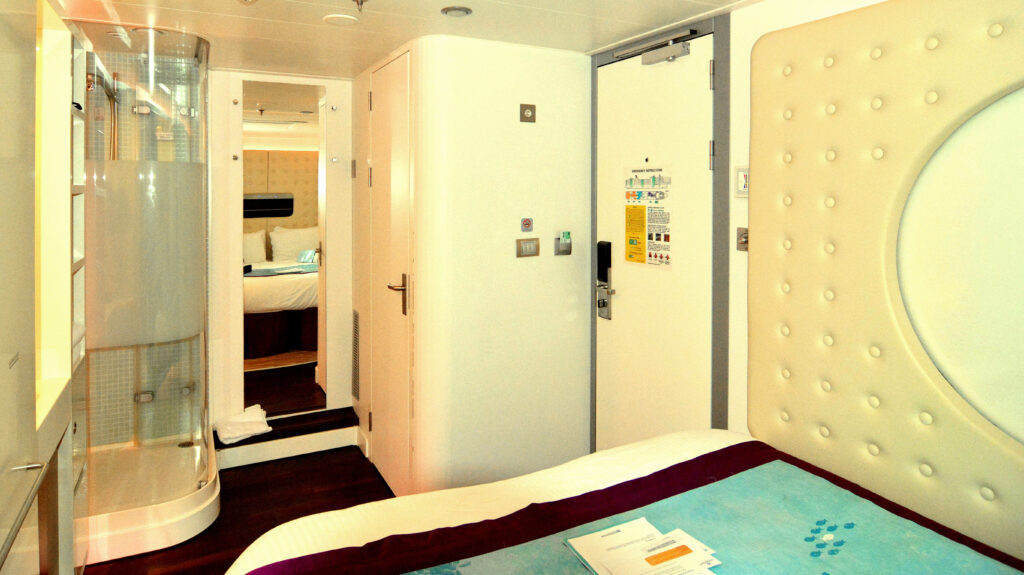
Quick answer: Compare the total booking price for everyone travelling, not just the advertised per-person fare. Request inside, ocean-view and balcony quotes for the same sailing, guest ages and booking terms. Solo travellers should price one guest explicitly; families should compare one suitable cabin against two rooms. Choose the least expensive arrangement that meets your sleeping, bathroom, location and view requirements.
A cabin upgrade is worth considering when its whole-party premium buys something you will use. That might be daylight, outdoor seating, separate sleeping space or a second bathroom—not simply a higher category name.
This guide uses Royal Caribbean’s published policies as specific examples, not industry-wide rules. Research is dated November 29, 2026; monetary calculations are in US dollars. Comparable live fares for all the required occupancy arrangements were not verified, so the worked comparisons use published charges and formulas rather than invented cruise prices.
1. Start with a matched quote for your whole party
Royal Caribbean’s published single-occupancy policy says its posted rates are based on double occupancy. Its special-pricing FAQ also explains that third and fourth guests sharing with two full-fare guests may receive different rates. Consequently, multiplying a headline fare by your headcount is not a reliable substitute for a party-specific quote. (royalcaribbean.com)
For each cabin option, keep these details identical:
| Comparison field | What to record |
|---|---|
| Sailing | Ship, departure date, itinerary and number of nights |
| Travellers | Number of adults and children, with children’s ages |
| Booking market | Country of residence and currency |
| Cabin arrangement | One room or two; exact category and guest allocation |
| Assignment | Selected cabin number or cruise-line-assigned guarantee |
| Fare conditions | Deposit type, final payment and cancellation terms |
| Total | Full booking price, included charges and unpaid extras |
Use this budgeting calculation:
Comparable cabin cost = total booking price + relevant unpaid charges + extras needed to match the other option
Do not add a charge twice. If your quote includes prepaid gratuities, for example, keep them within the quoted total rather than adding them again.
For couples, divide the difference between two complete quotes by the number of nights. This shows the upgrade cost per cabin-night. Divide again by two only if a per-person figure helps you judge value.
Keep flights, hotels and transfers in the wider trip budget. If they are unchanged between cabin choices, they do not need to complicate the cabin comparison.
2. Compare the actual room—not just its category name
Royal Caribbean groups accommodation into interior, outside, balcony and suite categories, but says rooms and suites vary by ship. Its standard room amenities include a private bathroom and shower; a balcony is not necessary to obtain those basics. (royalcaribbean.com)
Treat the three main choices as a starting point:
| Cabin choice | Main feature to evaluate | Essential check |
|---|---|---|
| Inside/interior | Whether the room’s layout meets your needs without an ocean-facing window | Check the exact description: some interiors overlook ship spaces |
| Ocean-view | A view through a window rather than private outdoor seating | Verify window type, obstruction and sleeping arrangement |
| Balcony | Private outdoor space and its particular outlook | Confirm whether it faces the ocean or an internal neighbourhood |
These distinctions matter on specific ships. On Oasis of the Seas, Royal Caribbean lists ocean-facing balconies alongside Central Park and Boardwalk balconies. Its interior and ocean-view accommodation pages also identify different room variants. “Balcony” alone therefore does not establish the view you are buying. (royalcaribbean.com)
Before requesting prices, write down your non-negotiables: separate beds, an acceptable bed for each child, a particular bathroom arrangement, daylight or an ocean-facing balcony.
When specifications list room area and balcony area separately, keep them separate in your comparison. Outdoor space does not replace indoor sleeping or storage space.
3. Solo travellers: distinguish the fare multiplier from the total bill
Royal Caribbean says a guest occupying a room alone is expected to pay 200% of the category rate unless the pricing states otherwise. That means twice the relevant per-person category rate—not an additional 200% on top. (royalcaribbean.com)
Here is a worked comparison without an invented fare.
Let P represent the applicable per-person cruise fare for two people sharing:
| Arrangement | Cruise-fare calculation under that stated rule |
|---|---|
| Two guests sharing | P + P = 2P |
| One guest occupying the room alone | 2 × P = 2P |
The room’s cruise-fare component can therefore be the same for one occupant as for two, while the amount per traveller is very different.
Do not extend that multiplier automatically to the entire invoice. Request the actual one-person quote, with its taxes, fees, promotions and other charges itemised. The published rule itself allows exceptions in the pricing. (royalcaribbean.com)
Gratuities illustrate why the distinction matters. Royal Caribbean’s policy supplied for this guide lists an automatic daily amount of $18.50 per guest for non-suite accommodation, unless prepaid. It describes gratuities as optional and adjustable or removable under its stated procedure. On a seven-night budgeting example:
- One guest: 1 × 7 × $18.50 = $129.50
- Two guests: 2 × 7 × $18.50 = $259.00
Those calculations use the published gratuity policy, not a verified sailing quote.
For your shortlist, ask for the final one-person total for each acceptable category. Do not assume that a lower advertised double-occupancy fare produces the lowest solo bill.
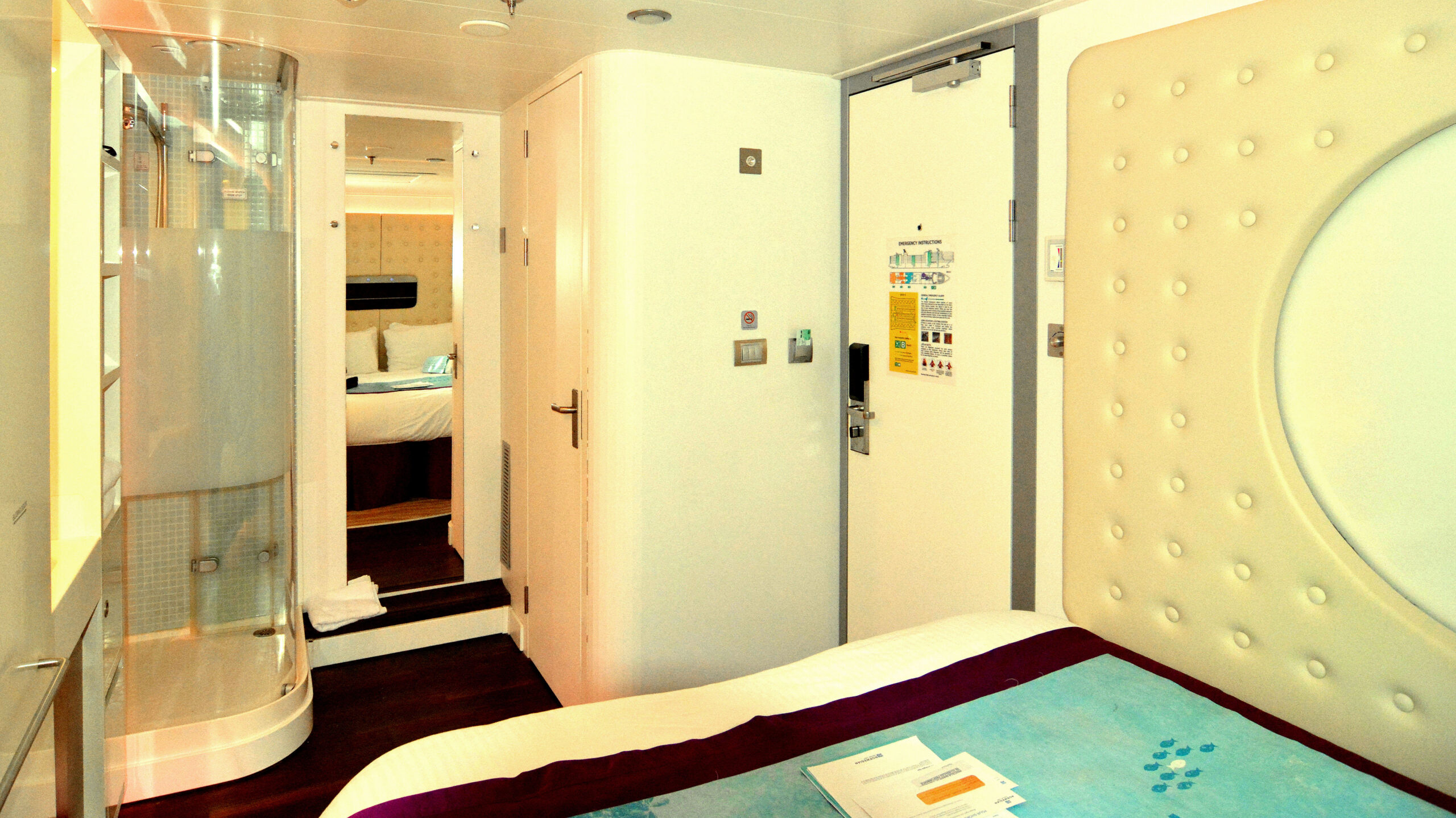

4. Families: compare one suitable cabin against two complete room quotes
Royal Caribbean says third- and fourth-guest rates may be lower when those guests share a stateroom with two full-fare-paying guests. That is a possible saving, not a promise that one room always costs less than two. (royalcaribbean.com)
For two adults and two children, request:
- Option A: One cabin confirmed to accommodate all four.
- Option B: Two suitable rooms, with two guests assigned to each.
- Option C, if relevant: Two connecting rooms with confirmed cabin numbers.
Use this worked comparison:
One-room total = guest 1 + guest 2 + guest 3 + guest 4 + charges not already included
Two-room total = complete room 1 quote + complete room 2 quote + charges not already included
Then calculate:
Two-room premium = comparable two-room total − comparable one-room total
A positive result is the extra cost of the two-room arrangement. A negative result means the two-room option is cheaper on those quotes.
The important distinction is that the third- and fourth-guest pricing in a shared room should not be carried over into a second room: the published special-rate description depends on sharing with two full-fare guests. (royalcaribbean.com)
Some costs cancel out. Using the same published non-suite gratuity amount, four guests on a seven-night example produce:
4 × 7 × $18.50 = $518
That budgeting amount is unchanged whether those four guests occupy one non-suite cabin or two. It should not be doubled merely because there are two rooms. This follows the operator’s per-guest daily policy.
Now assess what the premium buys. Two standard rooms provide separate sleeping spaces and two private bathrooms under Royal Caribbean’s stated standard-room amenities. Check the larger family cabin’s own specification rather than assuming it offers the same separation. (royalcaribbean.com)
Finally, confirm the actual beds. “Accommodates four” is not enough information for deciding who sleeps where.
5. Connecting rooms require confirmed locations and an age-policy check
Connecting rooms and nearby rooms solve different problems. If you need an internal connecting door, request that feature explicitly and confirm the cabin numbers before paying.
For North American departures, Royal Caribbean’s published policy generally requires someone aged 21 or older in a stateroom. It provides exceptions for children sailing with parents or legal guardians in connecting rooms, adjacent rooms, or rooms directly across the hall that open to the same hallway. The policy specifically advises checking how the doors open on the deck plan. (royalcaribbean.com)
Do not apply that exception to another operator or departure region without checking its own rules.
A guarantee booking is particularly important here. Royal Caribbean says it chooses the exact room and location, and that guests travelling together may not be berthed near one another. Consequently, two guarantee rooms are not a dependable choice when proximity is essential. (royalcaribbean.com)
Also avoid booking fewer guests now with the intention of adding children later. Royal Caribbean warns that ship or stateroom occupancy can affect whether additional guests can be added. Price and confirm the intended party from the outset. (royalcaribbean.com)
6. Check cabin location and inclusions before valuing an upgrade
Before paying more, examine the exact cabin on the sailing’s applicable deck plan. Practical checks include:
- What is directly above, below and beside it?
- How far is it from lifts and the places your party expects to use?
- Is the view described as obstructed?
- Is the balcony ocean-facing or inward-facing?
- Does the layout work with every bed in use?
These checks do not guarantee quiet or comfort. They help you identify questions to resolve before committing.
Royal Caribbean’s guarantee policy says assigned cabins may have obstructed views; on Oasis- and Icon-class ships, a balcony assignment may be a neighbourhood-view room. Compare guarantee quotes with selected-room quotes consciously rather than treating them as identical products. (royalcaribbean.com)
Separate the room upgrade from package benefits, too. Royal Caribbean’s fare-inclusions guide identifies Wi-Fi, specialty dining, beverage packages and excursions as optional additions; accommodation is included across room categories.
Ask what the exact fare includes. Do not credit a balcony with Wi-Fi or drinks unless the offer expressly includes them. Value a bundled benefit against what you would otherwise spend—not automatically at its advertised retail price.
7. Make the decision with a final booking checklist
Before paying a deposit, confirm:
- Everyone is included: Names, ages and room allocations match your intended party.
- The rooms work: Capacity, beds, bathrooms and any required connecting door are confirmed.
- The quotes match: Same sailing, currency, booking market and comparable assignment method.
- The totals are complete: Included charges are not added again; unpaid items remain budgeted.
- The terms are acceptable: Deposit, final payment and cancellation conditions are saved.
- The premium has a purpose: You can explain what the extra money buys your party.
Pay particular attention to deposit conditions. Royal Caribbean’s supplied cancellation policy says some fares require a nonrefundable deposit and associated change fees; its schedules also distinguish bookings by creation date and, in some cases, itinerary and departure date.
Save the quote and the terms applicable to it. A lower cabin total is not a like-for-like saving if it requires accepting a deposit or room-assignment risk you would otherwise reject.
The useful question is not simply “Is a balcony better?” It is: “What is the complete extra cost for our party, and does the confirmed room arrangement justify it?”